The efficiency and reliability of a natural-circulation heat-recovery system depend on maintaining satisfactory boiling conditions throughout every evaporator module. Several factors must be optimized.
Circulation Ratio
The circulation ratio is the mass flow of circulating water divided by the steam flow. It can be understood as the number of times water circulates through the evaporator before being converted fully into steam at steady pressure and temperature.
A high circulation ratio corresponds to a low steam fraction, while a low circulation ratio produces a higher steam fraction. Maintaining an appropriate liquid inventory and steam void fraction helps prevent tube overheating.
Wet-Wall Flow
Adequate wet-wall flow is required to maintain nucleate boiling under all operating conditions. Optimizing water velocity improves heat transfer by increasing turbulence while reducing the risk of steam blanketing, overheating, and deposition of entrained solids.
Water Chemistry
The reliability of the hydraulic and thermal design is also linked directly to the selected chemical treatment program. Chemistry-related problems can alter water velocity, disturb hydraulic stability, and ultimately reduce heat transfer.
Water conditioning depends on makeup-water quality, the treatment program selected for the cycle, the performance of the drum internals, and the blowdown-system design.
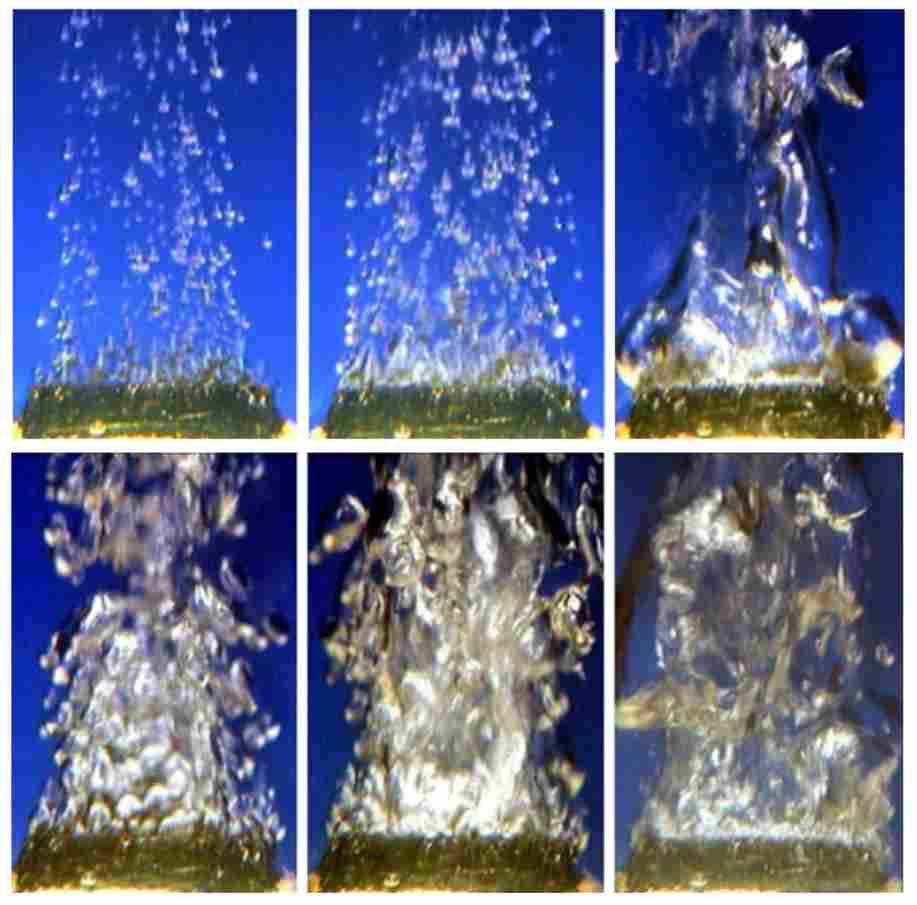
The featured image represents conditions analogous to water flow through a boiler tube at different heat inputs.
Photo source: Institute for Space and Nuclear Power Studies, University of New Mexico.