This case shows how a small defect in a multimedia filter caused major downstream consequences, compromised the integrity of reverse osmosis membranes, and demonstrated the importance of a robust, reliable design.
What Was Observed
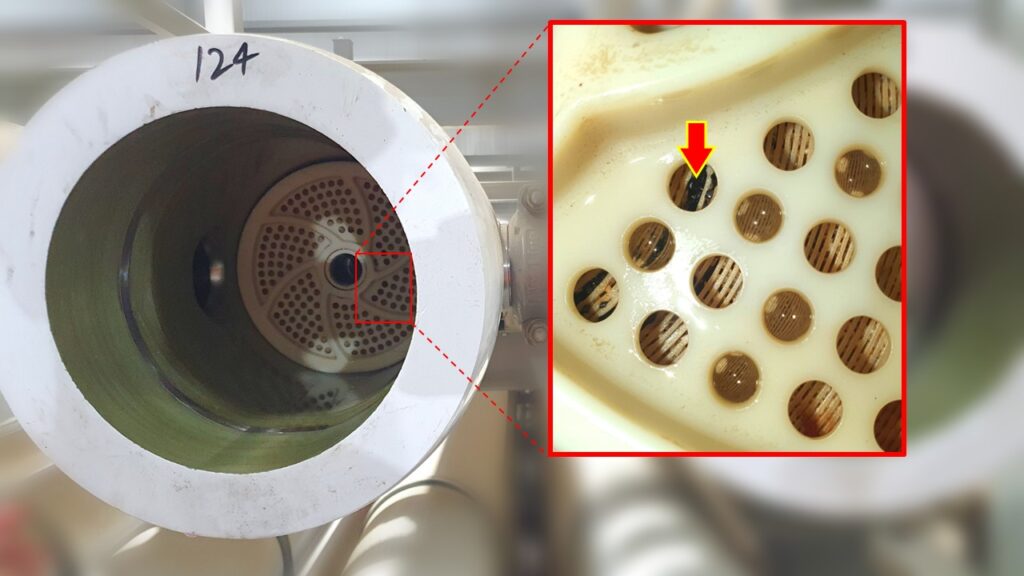
The featured image was taken at the inlet of a reverse osmosis (RO) pressure vessel. It shows the multi-orifice protection cover and the membrane sheets wound around the central permeate tube in a spiral-wound configuration.
The inlet flow channels were visibly deformed and blocked by black particles identified as anthracite. How did these particles travel through the system and reach the membranes?
Anthracite is commonly used as one of the main media in multimedia pretreatment filters because of its high filtration capacity. Its purpose is to capture suspended particles before the water reaches the RO membranes. However, a failure within a multimedia filter can allow filter media to carry over into the downstream system and cause severe operational problems.
How the Failure Developed
In large-scale water treatment plants, multimedia filters are often constructed on site as part of the civil works. The base supporting the sand and anthracite may consist of prefabricated concrete slabs installed side by side. The joints between the slabs, and between the slabs and the walls, are sealed with a silane-terminated polymer.
Failure of the slab-joint seals allowed anthracite particles to escape into the filtered-water section. The particles then traveled through the system, passed through the cartridge filters, and became embedded in the RO membrane feed channels, causing severe fouling, damage, and ultimately a plant shutdown.
Although prefabricated slabs are faster and more cost-effective to install, the potential consequences of a joint failure make a single, continuous reinforced-concrete slab cast in place and tied into the filter walls a more reliable solution. This approach eliminates slab joints and joint-sealing polymers, producing a more robust design.
In media filtration, even a small construction oversight can create major downstream consequences.
Operational Impact
At this desalination plant in Southern Europe, the failure caused severe membrane fouling. The entire system was shut down for 30 days, followed by another 20 days of operation at partial load. By the time the problem was identified, filter media had spread throughout the piping network.
Determining which filters had cracked was difficult. Every media filter had to be inspected, followed by checks of all cartridge filters and replacement of their elements. Pump suctions, valve seats, and every location where media could accumulate and damage in-line equipment also required inspection. Finally, each RO pressure-vessel cover was opened so the membranes could be inspected individually. This labor-intensive process contributed significantly to the downtime.
Once some systems were restored, the plant operated at reduced output while maintenance continued. This partial-load operation was necessary because only a limited number of systems and RO skids were available, while the plant still needed to supply part of the region’s water demand.
The associated costs included membrane replacement, extended operational downtime, specialist labor, and financial penalties for failing to meet contractual water-supply obligations.
Key Lesson
This case demonstrates the importance of robust system design, correct construction practices, and close supervision—from material selection to installation quality. Properly designing and sealing the multimedia-filter floor would have prevented the chain of failures that followed.
Have you encountered an unexpected failure in a treatment system? Share your experience, and let’s learn together.