Flash steam forms when hot water or condensate undergoes a sudden pressure reduction below its saturation pressure, causing part of the liquid to vaporize immediately.
How Flashing Causes Damage
The expansion is approximately isenthalpic: part of the liquid’s sensible heat supplies the latent heat needed to form steam. The resulting two-phase flow contains vapor and entrained liquid droplets.
This mixture can be highly abrasive because the droplets continuously strike surrounding surfaces. Flashing can also generate vibration, excessive noise, wear, and material erosion, potentially leading to irreversible failure.
If process-water quality is poor, the pressure reduction can also precipitate chemical compounds, deposit impurities, and accelerate deterioration. A related example is described in Chemical Corrosion Damage in Adiabatic Expansions.
Control-Valve Exposure
Control valves are especially susceptible to flash-steam damage. As fluid passes through a valve restriction, the local pressure can fall sharply and initiate boiling. Vapor bubbles and liquid droplets then strike the trim continuously.
Because the mass flow must be maintained through the restricted area, local velocity increases and intensifies the wear.
In high-pressure systems, hot drain condensate may discharge through a valve into a low-pressure flash tank. Under these conditions, flow can approach sonic velocity and choke in the flashing zone, causing the degradation rate to rise sharply.
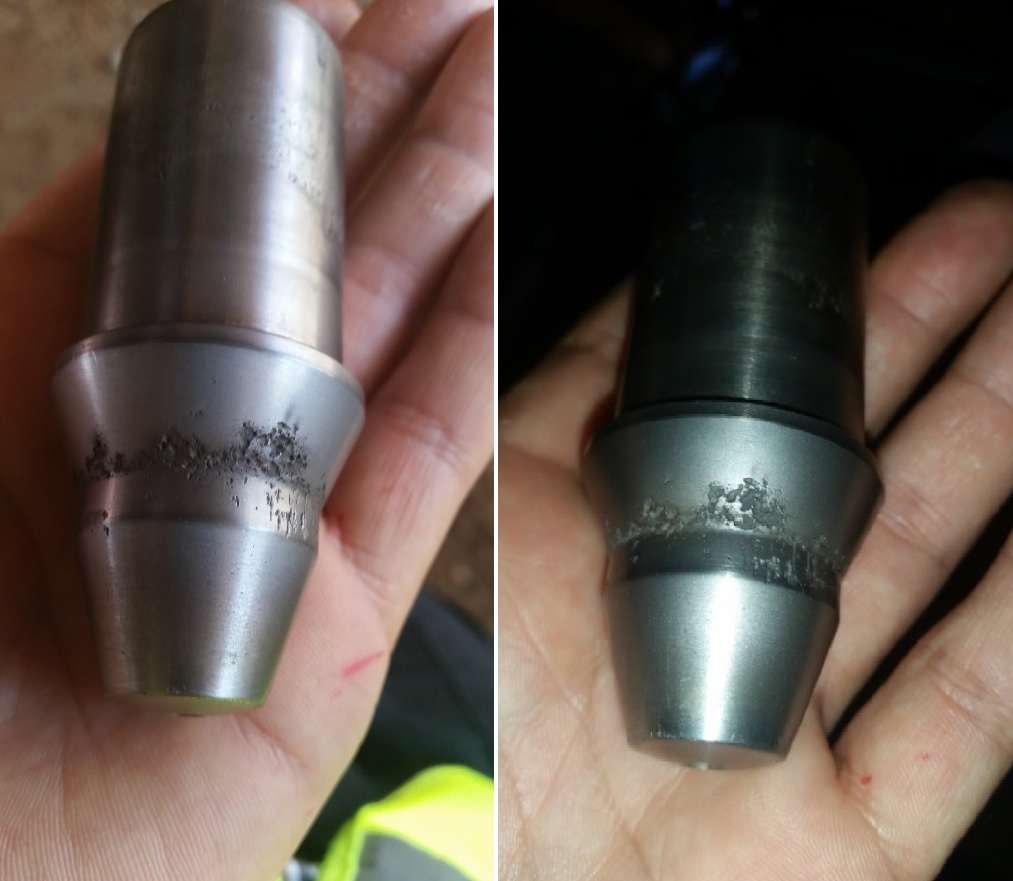
The featured image shows impingement damage on a valve plug in a high-pressure drain system. The damage resembles abrasion by solids, although no solids were present.
We documented this condition during the start-up of a power plant. Most high-pressure drain valves were severely damaged and displayed the same erosion pattern. Some valves could be repaired by lapping the affected surfaces, while others had to be replaced.
Strategies for Managing Flash Steam
Flashing is inherent to certain operating conditions, so the first step is to understand the process well enough to predict where it will occur. It may not always be possible to eliminate flashing, but appropriate design measures can control where it develops and reduce its consequences.
Material Selection
Materials must withstand both the physical and chemical effects of flashing. Stellite is a cobalt-based alloy containing approximately 30% chromium and is widely used for wear and corrosion resistance at elevated temperatures.
In this case, the valve plugs were made from 316 stainless steel and had no Stellite overlay or hardened trim shield to protect the seating surface. Despite the good corrosion resistance of 316 stainless steel, it could not withstand the service conditions.
Relocating the Flashing Zone
A sacrificial orifice plate can be installed downstream of the valve to increase backpressure. This reduces the pressure drop across the valve and shifts the most severe flashing to the orifice-plate area, where the sacrificial component can be replaced more easily.
Internal Protection
A drilled-hole cage can divide the pressure drop into smaller stages, reduce the size of the vapor structures, and limit flash-steam damage.
Valve Design
A multistage-trim control valve or an angle valve can dissipate the released energy more gradually and reduce degradation.
Another option is a reverse-flow plug arrangement that moves the restriction downstream of the valve seat. Flashing and the highest-velocity flow then occur beyond the plug, away from the seating surface.
Conclusion
Flash steam occurs when hot condensate pressure falls rapidly below the liquid’s saturation pressure at the prevailing temperature. Critical flashing zones should be identified through detailed process analysis. A complete mitigation plan may combine several of the following measures:
- Adjust process conditions to minimize or eliminate flashing.
- Select more resistant materials for the expected service.
- Use energy-dissipation designs to control flashing.
- Relocate the flashing zone to a safer, replaceable section.
- Select a valve design suited to flashing service.
The most effective solution often combines several of these strategies.