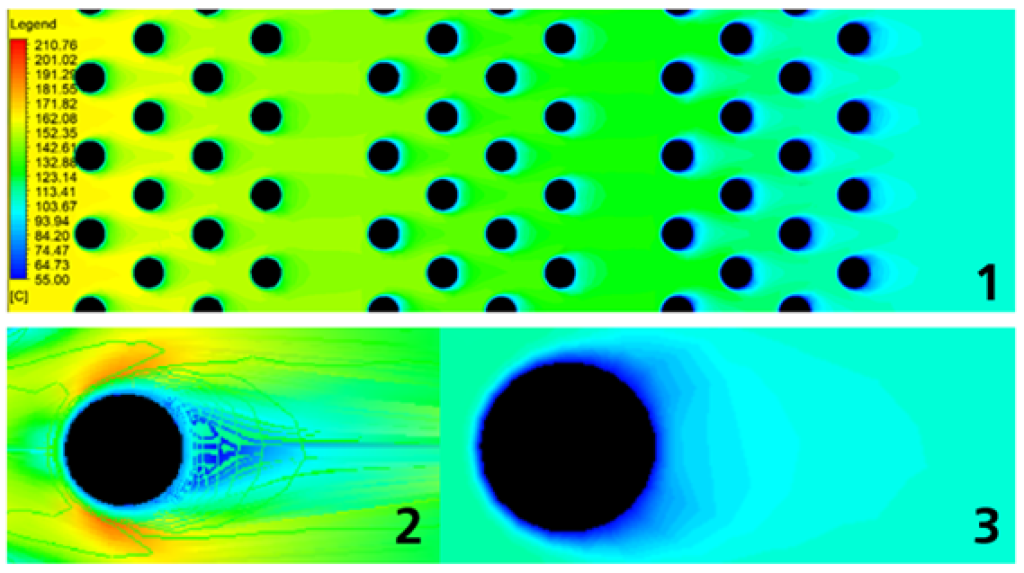
A computational fluid dynamics (CFD) simulation was performed to study the effect of flue-gas velocity through the final-stage modules of a heat recovery steam generator (HRSG) preheater.
Purpose
The simulation produced a temperature map of the preheater module, making it easier to understand how energy is distributed across the tube bank. It also provided information that could be used to identify areas of low efficiency and develop optimization strategies.
Simulation Findings
The model represents a cross-sectional top view of an HRSG preheater module and shows how temperature varies across the back-end tubes. Higher flue-gas velocity creates pressure gradients between opposite sides of a tube, which can generate vortices and turbulence in its wake.
This recirculation can reduce local velocity close to the tube surface and lower the rate of energy transfer from the flue gas to the condensate. Insufficient flue-gas circulation around the tubes can also reduce local temperatures below the dew point and allow condensation droplets to form. A condensate film on the tube surface can then alter both convective heat transfer and conduction through the tube wall.
Why It Matters
Back-end corrosion can occur when gas-turbine exhaust temperatures fall below the dew point of acidic combustion products. If the fuel contains sulfur, combustion produces sulfur dioxide in addition to carbon dioxide and water. Some sulfur dioxide oxidizes to sulfur trioxide, which combines with water vapor to form sulfuric-acid vapor.
If the flue-gas temperature falls below the acid dew point, sulfuric acid can condense on the affected surfaces. The severity of the attack depends on the acid concentration in the condensate and on the H2O–H2SO4 equilibrium.
Design Value
The CFD results identify areas where condensation is most likely to occur, allowing suitable mitigation measures to be incorporated during HRSG design.
Related case: Sulfur Dew-Point Corrosion.