Material selection must balance design cost with the required operating performance. Commissioning introduces demanding transient conditions that can be more severe than normal operation and may exceed the design conditions of in-line equipment.
Commissioning Risk
Commissioning strategies should therefore be reviewed in advance to identify equipment that may experience critical conditions and to ensure that appropriate materials are specified.
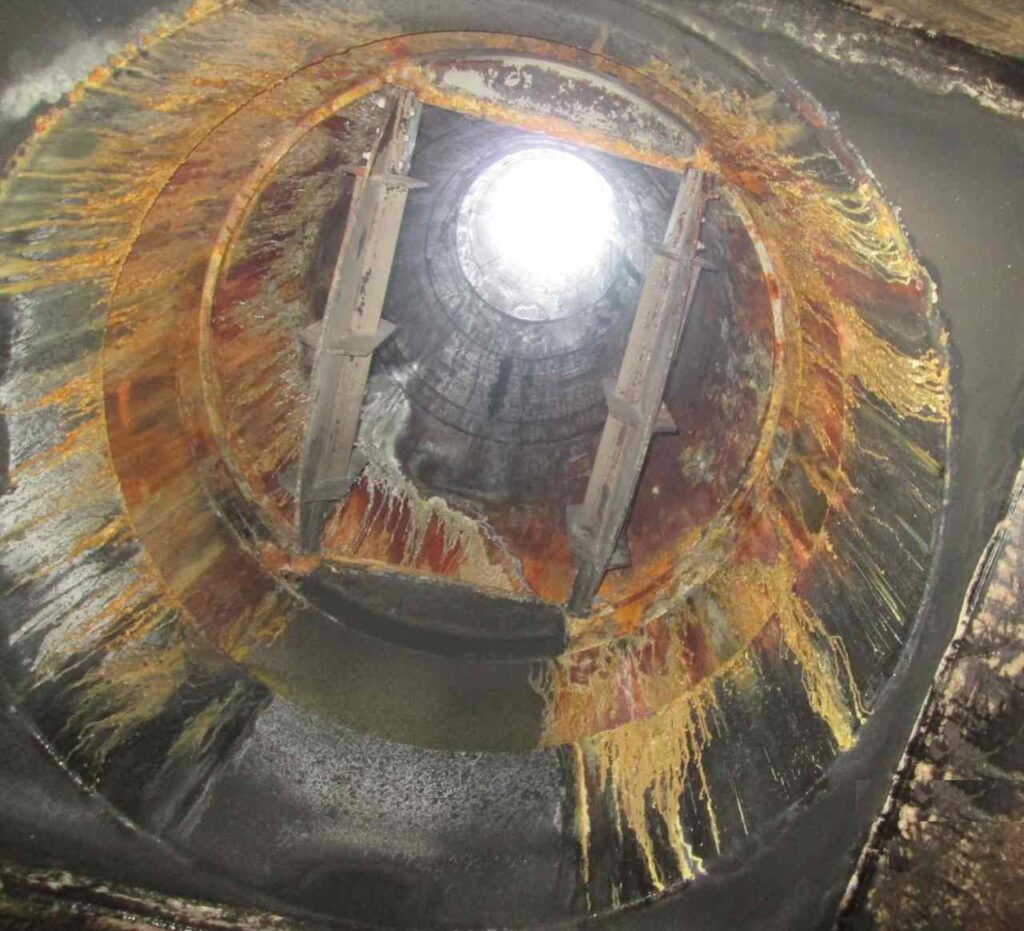
The featured image was taken at the bottom of a diesel-heater stack and shows the severe effects of acid dew-point corrosion.
Corrosion Mechanism
When sulfur-bearing fuel is burned, sulfur is oxidized mainly to sulfur dioxide (SO2) and, to a lesser extent, sulfur trioxide (SO3) in the presence of combustion products such as carbon dioxide and water vapor.
Sulfur trioxide combines with water vapor to form sulfuric-acid vapor (H2SO4). If the temperature falls below the acid dew point, sulfuric acid condenses on the metal surfaces.
At first, a highly concentrated sulfuric condensate may react with iron to form a protective layer of iron sulfate, limiting immediate attack on carbon steel. The situation changes when the flue-gas temperature falls below the water dew point and additional condensation dilutes the sulfuric acid.
As the acid becomes more dilute, dissociation produces more hydrogen ions and corrosion can accelerate rapidly, damaging the metal within hours.
Prevention
From an engineering and design perspective, the damage could have been prevented by analyzing the fuel composition, determining the relevant acid and water dew points, and selecting a more resistant stack material.