A sudden change in a flow passage—typically an increase in cross-sectional area—can cause water pressure to fall rapidly below the saturation pressure at its temperature, producing instantaneous vaporization.
Expansion and Flashing
Because the process is approximately adiabatic, there is no external heat exchange and total enthalpy remains essentially constant. Part of the liquid flashes into steam by absorbing latent heat from the remaining fluid.
This phenomenon can create severe chemical and mechanical damage in steam-water systems. Consequences may include sediment accumulation, under-deposit corrosion, overheating, caustic corrosion, control-valve obstruction, and spray-nozzle clogging.
Typical Locations
The problem is commonly found at low-pressure drain motorized valves feeding flash tanks; spray nozzles and diffusers in bypass attemperators; orifice plates; nozzle and Pitot flowmeters; low-pressure flash-tank drains to the condenser; and blowdown systems. We have also observed similar corrosion patterns at deaerator nozzles.
Precipitation and Corrosion
The solubility of chemical species depends strongly on pressure, temperature, and other fluid properties. Although there is no single correlation that applies to every compound, the solubility of many species decreases as these conditions change.
When water expands to a pressure below its saturation pressure, some impurities can exceed their solubility limit and precipitate. These salt deposits may be highly aggressive. Sodium salts can hydrolyze and promote caustic corrosion. Silica can form a hard, impervious scale that may contribute to stress-corrosion cracking. Sodium carbonate or sodium chloride can adsorb onto the metal surface and weaken its passive protective layer. Under-deposit corrosion can then develop through electrochemical reactions beneath the accumulated salts.
Field Example
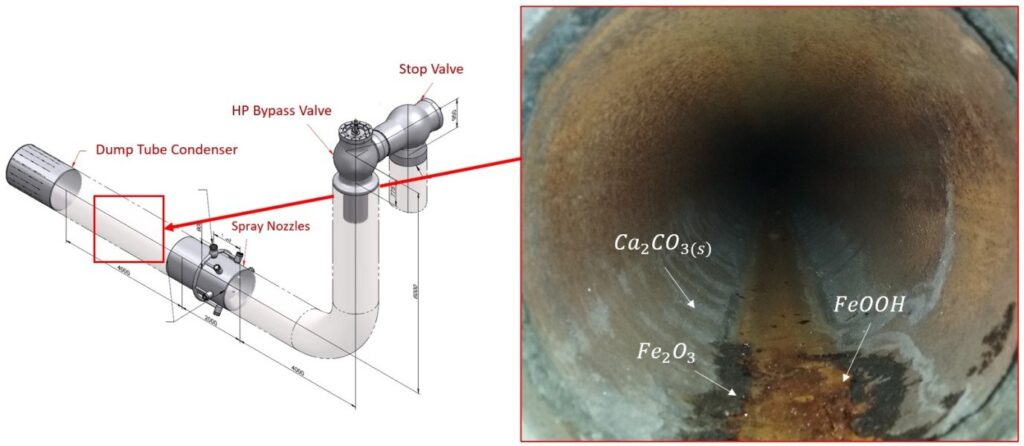
The featured image was taken during an inspection and shows calcium-carbonate deposits—the light-colored patterns—downstream of a high-pressure spray-attemperator bypass valve.
Air ingress into the condenser produced elevated levels of dissolved carbon dioxide and carbonic-acid species. These species reacted with dissolved calcium to form calcium carbonate. During the abrupt expansion through the spray attemperator, the equilibrium among the dissolved species was disrupted. Some volatile species flashed and were carried into the steam flow, while other impurities exceeded their solubility limit and precipitated as insoluble salts.
Related case: Sulfur Dew-Point Corrosion.