Failures during commissioning activities such as chemical cleaning or steam blowing may remain hidden for the first months of operation, yet they can have a direct and lasting impact on power-plant performance.
This case examines damage to the regeneration system of a concentrated solar power (CSP) plant and explains how it reduced plant productivity. Solar power plants operate according to the principles of fluid mechanics and thermodynamics. The mass and heat balance is therefore the foundation of the system design and the plant performance model.
The Role of Regeneration
A performance model defines how the plant should operate under ideal conditions. Its results provide a reference for operating the plant as close as possible to the theoretical model, identifying deviations, understanding system behavior, and improving overall efficiency.
Plant efficiency depends on the performance of every individual system. Regeneration is particularly important because it raises the feedwater temperature before the water enters the solar steam generator (SSG). Feedwater heaters accomplish this by using bleed steam extracted from different stages of the steam turbine.
Regeneration reduces the required thermal input, lowers the enthalpy rise required in the SSG, minimizes the risk of thermal shock in the preheater, and improves overall efficiency. Any departure from the expected performance of the regeneration system therefore reduces plant output.
Plant Configuration
The plant uses parabolic-trough technology to capture solar energy in a heat-transfer fluid (HTF). The HTF transfers its enthalpy to high-purity water in the SSG to produce superheated steam. In this counter-current arrangement, the hot oil first superheats the steam, then boils the water in the evaporators, and finally preheats the feedwater in the economizer. Heat-transfer efficiency depends strongly on the feedwater temperature at the economizer inlet.
The superheated steam expands through a steam turbine and exhausts to a surface condenser. The hotwell serves as a reservoir from which condensate is pumped back into the cycle.
A bank of feedwater heaters arranged in cascade raises the water temperature before it reaches the SSG economizer. H3 and H4 are low-pressure heaters, while H1 and H2 operate at high pressure. All are shell-and-tube heat exchangers: water flows through the tube side while bleed steam condenses on the shell side. The deaerator is a direct-contact heat exchanger that removes oxygen, carbon dioxide, and other volatile impurities.
Failure Investigation
During the first months of operation, H1 and H2 showed a gradual decline in thermal performance and created collateral problems across the cycle. A failure investigation was therefore conducted to identify the root cause and define corrective actions.
The analysis showed that both heaters had been damaged during project commissioning. They were included in the chemical-cleaning and initial-flushing scope, but insufficient measures were taken to protect them. H2 effectively became a filter, and a large quantity of metal debris became trapped in its tubes. Because of the resulting damage and leakage, the heater had to be replaced one year later.
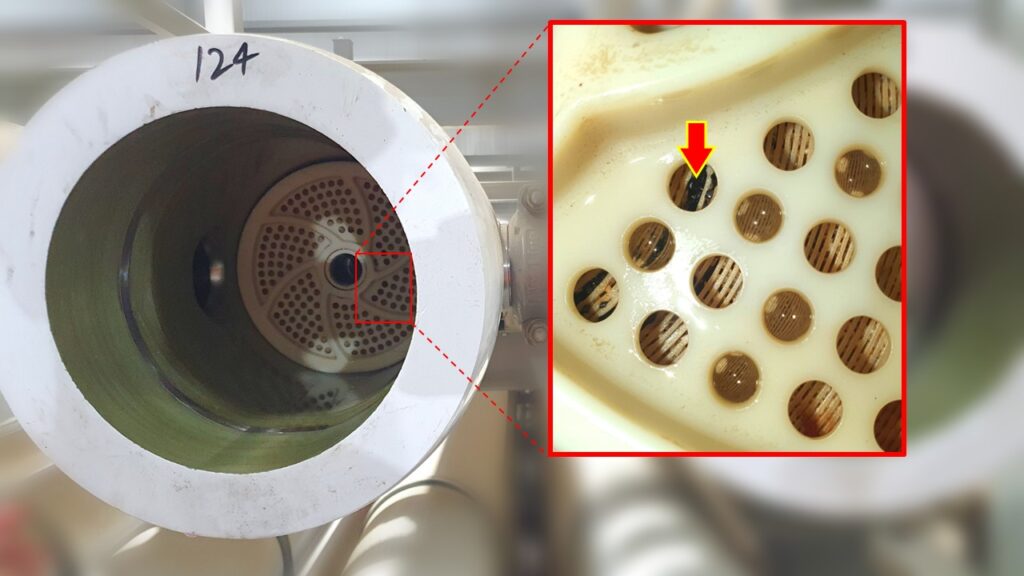
The featured image shows the front tube sheet of H2. Countless eroded metal fragments, welding slag, and stones were embedded in the tubes, leaving more than 55% of the tube bundle permanently blocked.
The problem was detected partly through excessive power consumption by the feedwater pumps. Flow restrictions through the heaters increased friction losses, forcing the pumps to run faster to overcome the pressure drop. This pushed them beyond their preferred operating range and reduced efficiency. If sustained, the resulting temperature increase could bring the water toward its boiling point and cause cavitation, vibration, or mechanical damage to rotating components.
The metal debris and material incompatibility also promoted several forms of corrosion, and some tubes began to leak. Because the water-side pressure was approximately 80–100 bar higher than the steam-side pressure, water leakage into the shell reduced the steam temperature by several degrees. This weakened heat transfer, lowered deaerator pressure, and could affect water quality.
These instabilities ultimately forced operators to open the H2 manual bypass and leave the heater out of service.
Impact on Plant Performance
Bypassing H2 reduced the average feedwater temperature at the preheater inlet by approximately 25 °C. Under some conditions, this lost enthalpy could be compensated by bringing additional parabolic-trough collectors into solar tracking, increasing HTF flow and thermal input.
The problem remained hidden during the first months because H1 and H2 were out of service or operated intermittently in summer mode. Closing the first and second turbine extractions increased steam flow through the turbine and raised nominal gross production by approximately 5%. In winter, however, the full solar field was already required to maximize output, leaving no additional solar capacity to compensate for the lower feedwater temperature. The plant therefore had to accept a loss of efficiency.
The failed heaters created another performance penalty. With a lower preheater inlet temperature and no additional heat from turbine extractions, the SSG required more time to reach its nominal operating point during daily start-up. The plant also lost thermal inertia during daily shutdown.
Commissioning Lesson
Commissioning is one of the most critical stages in a power plant’s life because systems and equipment are exposed to demanding transient conditions. A design or execution failure during field activities can damage critical equipment and create long-term deviations from expected performance.
Continuous inspection and comprehensive system monitoring are therefore essential during start-up. Critical commissioning activities should also be supported by a dedicated hazard and operability analysis.
Related case: Acid Cleaning Corrosion.