Cooling towers reject heat through the partial evaporation of circulating water. This evaporation rapidly concentrates the chemical species naturally dissolved in the water.
Scale Formation
The principal scale found in cooling towers is calcium carbonate, which forms from the decomposition of calcium bicarbonate. Other deposits may contain magnesium-, sodium-, or silica-bearing compounds. Their solubility depends on conductivity, hardness, pH, and temperature.
Without adequate control, increasing salt concentrations can compromise system integrity and reduce efficiency. In a more severe scenario, deposits formed in the cooling tower can travel to the condenser, create hard scale, and interfere with steam condensation. If the cooling system cannot reduce the condenser temperature sufficiently, condenser vacuum will decrease and overall plant efficiency will suffer.
Blowdown Control
The problem can be managed through an appropriate chemical treatment program and an effective blowdown system. Cooling-tower operation is commonly assessed by the cycles of concentration: the ratio between the concentration of dissolved solids in the circulating or blowdown water and that in the makeup water. Optimizing this ratio reduces scale potential, lowers water consumption, and limits blowdown volume.
Monitoring and controlling blowdown quality and flow are essential. A control valve can be linked to a conductivity meter so that the controller automatically adjusts the blowdown flow and maintains conductivity close to its set point. The correct set point depends on the cooling-tower materials and the chemical treatment program.
Chemical Control
Acid dosing is often used to keep carbonate species below their saturation limit. Lowering pH shifts the carbonate equilibrium toward more soluble forms. This can permit operation at a higher conductivity set point and more cycles of concentration while reducing salt deposition.
Observed Damage
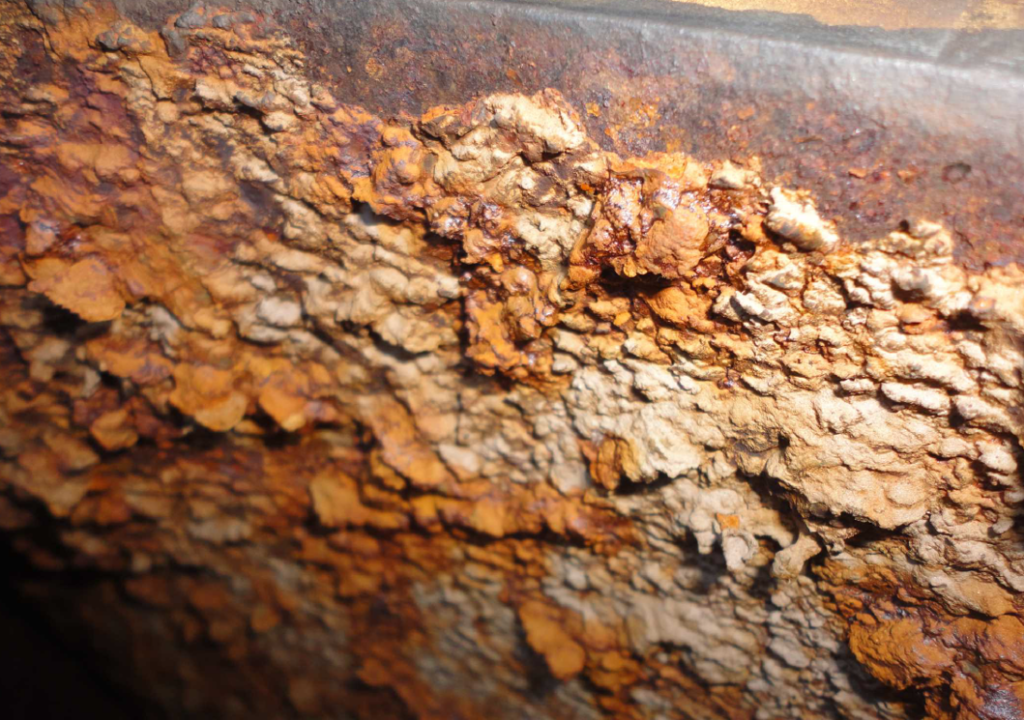
The featured image shows the consequences of an imbalanced blowdown regime, aggravated by inadequate chemistry control. In this case, the principal contributors were high chloride concentration and excessive conductivity.